🦸 Grade 7 Math (NJ) · session 2 of 48 · 60 minutes · free

Multi-step equations and inequalities

Mission 2 is a fix-up mission for the two skills that trip students up most in this unit. First, multi-step equations: tidy each side, gather the x's, then undo. Then inequalities: the same moves, one new rule, and a number line that shows every answer at once.

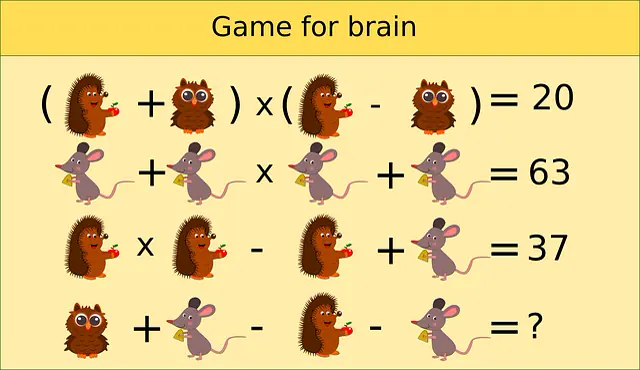
A picture maths puzzle with animals standing for numbers
Illustration: simonjozsef / Pixabay

A complete lesson · 60 minutes

Teach it, see it, practise it, all on this page.

Open this page with your learner and work down it, or press Teach this lesson to go through it one step at a time on a big screen. Every section has something to do.

See the teacher's plan
  1. Mental Maths Arcade8 min
  2. Recall game3 min
  3. Tidy first10 min
  4. Gather the x's9 min
  5. Inequalities and the flip10 min
  6. At least and at most6 min
  7. Level 3 · Advanced5 min
  8. Level 4 · NJSLA challenge3 min
  9. Level 5 · Real-world modelling3 min
  10. Exit ticket3 min

By the end you can

  • Solve multi-step equations: expand brackets, combine like terms, then undo
  • Gather x on one side when it appears on both sides, and clear fractions by multiplying by the LCD
  • Solve and graph inequalities, turning the sign round when multiplying or dividing by a negative
  • Write and solve inequalities for 'at least' and 'at most' stories, and round the way the story allows

Before you start

  • Two-step equations px + q = r (Mission 1)
  • Combining like terms and the distributive property

Have ready

  • This page (the number line and the checks are on screen)
  • A notebook: one step per line, with the move written beside it
  • A pencil and a ruler for number lines

Grade 7 · ages 12 to 13 · NJSLS-M 2023 · NJSLA Grade 7

Warm-up · think first

Recall game: solve 4x − 7 = 21 and −2x + 5 = 17 in your head.

Show the answer

x = 7 (4x = 28) and x = −6 (−2x = 12).

Teacher tip: Ask which move comes first and why: undo the + or − before the × or ÷.

🎬 Warm-up mission More warm-ups for every class →

🎮 Mental Maths Arcade · 7 rounds

Play with Captain Calc

Eight minutes in Captain Calc's Superhero lab. Work it out in your head, say why, then reveal. Accuracy first, speed second.

  1. Number Ninja: 3(4 − 7) − (−2)(5) = ?
    Answer: 1. 3 × (−3) = −9, and taking away (−2)(5) = −10 is adding 10: −9 + 10 = 1.
  2. Odd one out: which expression is NOT equal to the others? (3x − 6 · 3(x − 2) · 5x − 6 − 2x · 4(x − 2) − x)
    Answer: 4(x − 2) − x: it simplifies to 3x − 8. The other three are all 3x − 6.
  3. Estimate: you have $40 and save $18 a week. About how many weeks until you have $250?
    Answer: 12: (250 − 40) ÷ 18 = 210 ÷ 18 ≈ 11.7, so you pass $250 in week 12.
  4. If −2x > 6, then x is negative. (Always · Sometimes · Never)
    Answer: Always — Always: −2x > 6 means x < −3, and every number below −3 is negative.
  5. Would you rather: plan A costs $12 plus $3 a game, plan B costs $5 a game. You play 5 games. (Plan A · Plan B)
    Answer: Plan B: A costs 12 + 15 = $27 and B costs $25. At 7 games it swaps: A is $33 and B is $35.
  6. Find the Mistake: Jay solved −3x < 12 and wrote x < −4. Is Jay right?
    Answer: No: dividing by −3 turns the sign round, so x > −4. Test x = 0: −3(0) = 0 < 12 is true, and 0 > −4.
  7. Boss Battle: I think of a number, take away 4 and multiply by 3. I get double my number. What is it?
    Answer: 12: 3(n − 4) = 2n gives 3n − 12 = 2n, so n = 12. Check: 3 × 8 = 24 = 2 × 12.

Three levels, like a real engineer

Use it. Tweak it. Build it.

First use what the lesson shows exactly as it is, then change one key thing and see what happens, then make your own.

  1. 🔒

    Level 1 · Use it

    Run It Whole

    Copy the worked example 5 − 2(x − 4) = 21 line by line, exactly as written. After each line, say out loud what changed: brackets gone, like terms joined, or x alone.

  2. 🔧

    Level 2 · Tweak it

    Turn One Number

    In 5 − 2(x − 4) = 21, change the 2 to a 3 and predict the new x before you solve. Check it, then flip the minus to a plus and predict again.

  3. 🛠️

    Level 3 · Build it

    Build Your Own Story

    Invent your own 'at most' or 'at least' story, like a lift holding at most 500 kg. Write the inequality, solve it, graph it, then round your answer the way your story allows.

🗺️ Play the Lesson QuestThree worlds, one for each level, with short stages that bring back what you miss.

Part 1 of 4 · learn, see, practise

Tidy first: brackets and like terms

Agent X has wrapped the equation in brackets and scattered extra x's around it. Captain Calc's rule: tidy each side first, then solve the two-step equation that is left.

A multi-step equation needs tidying before the two familiar moves. Step 1: expand brackets with the distributive property. Step 2: combine like terms on each side. What is left is a two-step equation.

Example: 3(x − 2) + 4 = 19. Expand: 3x − 6 + 4 = 19. Combine: 3x − 2 = 19. Then add 2 (3x = 21) and divide by 3: x = 7.

Watch the sign in front of a bracket. −2(x − 5) means −2 × x and −2 × (−5), which is −2x + 10. A minus sign alone, as in 9 − (x + 3), means −1 times each term: 9 − x − 3.

Why it works: expanding and combining never change the value of a side, so the balance stays level. Only the look of the equation changes.

Remember!
  • Brackets, then like terms, then the two undo moves.
  • A negative outside a bracket multiplies every term inside.
📝 Notes

5x − 2(x + 4) = 11 becomes 5x − 2x − 8 = 11, so 3x = 19 and x = 19/3. Answers do not have to be whole numbers.

A bracket divided by a number, like (x + 6)/3 = 5, can be undone by multiplying both sides by 3 first: x + 6 = 15, so x = 9.

Example 1

Solve 5 − 2(x − 4) = 21.

  1. Expand: −2 × x = −2x and −2 × (−4) = +8, so 5 − 2x + 8 = 21.
  2. Combine the numbers: 13 − 2x = 21.
  3. Take 13 from both sides: −2x = 8.
  4. Divide by −2: x = −4.
  5. Check: 5 − 2(−4 − 4) = 5 − 2(−8) = 5 + 16 = 21 ✓

Answer: x = −4

Practise it

Start with the warm-up and go as far as you can. The stretch questions are meant to be hard.

Warm-up

Warm-up

Core

Core

Core

Stretch 🔥

Answers (for the teacher)
  1. 4
  2. 5
  3. 7
  4. -3
  5. 5
  6. 7

Part 2 of 4 · learn, see, practise

Gather the x's: variables on both sides

Agent X is hiding on both sides of the balance now. Take the same number of bags off each side until every x is on one side.

When x is on both sides, first move all the x terms to one side by adding or subtracting the same x term on both sides. Then it is a two-step equation again.

5x + 3 = 2x + 15: take 2x from both sides to get 3x + 3 = 15, then 3x = 12 and x = 4. Removing the smaller x term keeps the number in front of x positive.

Clearing fractions: multiply every term on both sides by the least common denominator (LCD). For x/2 + 3 = x/3 + 5, multiply by 6: 3x + 18 = 2x + 30, so x = 12. Decimals work the same way with 10 or 100.

Sometimes the x's cancel completely. 2(x + 3) = 2x + 6 is true for every x: infinitely many solutions. 2x + 5 = 2x + 1 is never true: no solution.

Remember!
  • Gather the x's on the side that has more of them.
  • Multiply every term by the LCD to clear fractions.
  • The x's vanish: a true statement means every number works; a false one means no solution.
📝 Notes

8 − 3x = x − 4: add 3x to both sides to get 8 = 4x − 4, so 12 = 4x and x = 3.

0.2x + 1.5 = 0.5x − 0.3: multiply every term by 10 to get 2x + 15 = 5x − 3, so 18 = 3x and x = 6.

Example 1

Solve 5x + 3 = 2x + 15.

xxxxx3xx155x + 3 = 2x + 15
  1. Take 2 bags (2x) off both sides: 3x + 3 = 15.
  2. Take 3 from both sides: 3x = 12.
  3. Share by 3: x = 4.
  4. Check: 5(4) + 3 = 23 and 2(4) + 15 = 23 ✓

Answer: x = 4

Example 2

Solve x/2 + 3 = x/3 + 5.

  1. The LCD of 2 and 3 is 6. Multiply every term by 6: 3x + 18 = 2x + 30.
  2. Take 2x from both sides: x + 18 = 30.
  3. Take 18 from both sides: x = 12.
  4. Check: 12/2 + 3 = 9 and 12/3 + 5 = 9 ✓

Answer: x = 12

Practise it

Start with the warm-up and go as far as you can. The stretch questions are meant to be hard.

Warm-up

Warm-up

Core

Core

Core

Stretch 🔥

Answers (for the teacher)
  1. 3
  2. 3
  3. 2
  4. 15
  5. 10
  6. infinitely many

Part 3 of 4 · learn, see, practise

Inequalities: the same moves and one new rule

Agent X can now be a whole crowd of numbers. The answer to an inequality is a ray on the number line, and one rule changes: multiply or divide by a negative, and the sign turns round.

Solve an inequality with the same moves as an equation: tidy, gather the x's, undo + or −, then × or ÷. The answer is a set of numbers, such as x > 4.

The one new rule: multiplying or dividing both sides by a negative number turns the inequality sign round. 2 < 5 is true, but after multiplying both sides by −1 it is −2 > −5.

Graph the answer on a number line: an open circle for < or > (the number itself is not included), a closed circle for ≤ or ≥ (it is included), and an arrow towards the numbers that work.

Check with a test number from your answer and one from outside it. For −3x + 4 > 19 the answer is x < −5. Test x = −6: 18 + 4 = 22 > 19 ✓. Test x = 0: 4 > 19 ✗, as it should be.

Remember!
  • × or ÷ by a negative: turn the sign round.
  • Open circle for < and >, closed circle for ≤ and ≥.
📝 Notes

Adding or subtracting a negative never turns the sign: x − 7 < −2 gives x < 5.

You can avoid the flip by moving the x term instead: 4 − 2x ≥ 10 becomes 4 ≥ 10 + 2x, so −6 ≥ 2x and −3 ≥ x, which is x ≤ −3.

Example 1

Solve and graph −3x + 4 > 19.

−11−10−9−8−7−6−5−4−3−2−101x < −5
  1. Take 4 from both sides: −3x > 15.
  2. Divide both sides by −3 and turn the sign round: x < −5.
  3. Graph: an open circle at −5 and an arrow to the left.
  4. Check x = −6: −3(−6) + 4 = 22, and 22 > 19 ✓

Answer: x < −5

Example 2

Solve 2(x − 1) ≤ 5x + 7.

−9−8−7−6−5−4−3−2−10123x ≥ −3
  1. Expand: 2x − 2 ≤ 5x + 7.
  2. Take 5x from both sides: −3x − 2 ≤ 7.
  3. Add 2: −3x ≤ 9.
  4. Divide by −3 and turn the sign round: x ≥ −3.
  5. Check x = 0: 2(−1) = −2 and 5(0) + 7 = 7, and −2 ≤ 7 ✓

Answer: x ≥ −3

Captain Calc's number line

Tap a number to move the circle, then choose open or closed and the direction of the arrow.

  1. Show x < −5.
  2. Show x ≥ −3.
  3. Show the answer to 3(x + 2) < 5x − 4.

Practise it

Start with the warm-up and go as far as you can. The stretch questions are meant to be hard.

Warm-up

Warm-up

Core

Core

Core

Stretch 🔥

Answers (for the teacher)
  1. x > -4
  2. x ≤ 5
  3. x ≤ -6
  4. x > 5
  5. x ≥ 10
  6. x < -2

Part 4 of 4 · learn, see, practise

At least and at most: inequalities in stories

Captain Calc's hero team has a budget and a target. 'At most' is a ceiling, 'at least' is a floor, and the answer has to make sense in the story.

Key words: 'at most', 'no more than' and 'maximum' mean ≤. 'At least', 'no less than' and 'minimum' mean ≥. 'More than' is >, and 'less than' or 'fewer than' is <.

Write the inequality the way you would write an equation, fixed amount + rate × number, then the sign and the limit. A $40 gift card, a $5 game you must buy, and songs at $1.29 each: 5 + 1.29s ≤ 40.

Then interpret the answer. 5 + 1.29s ≤ 40 gives s ≤ 27.13…, but songs are whole, so at most 27 songs. For a maximum round down; for a minimum round up.

Fixed cost + variable cost = total cost works in equations and inequalities alike. A club has raised $120, sells tickets at $8 and needs at least $500: 120 + 8t ≥ 500, so t ≥ 47.5, which means at least 48 tickets.

Remember!
  • At most is ≤; at least is ≥.
  • Whole things: round down for a maximum, up for a minimum.
📝 Notes

Check the boundary: 27 songs cost 5 + 34.83 = $39.83 (it fits) and 28 songs cost $41.12 (too much).

A range needs two inequalities at once: a score between 80 and 90 inclusive is 80 ≤ s ≤ 90.

Example 1

A club has raised $120 and sells raffle tickets at $8 each. It needs at least $500. How many tickets must it sell?

  1. Write the inequality: 120 + 8t ≥ 500.
  2. Take 120 from both sides: 8t ≥ 380.
  3. Divide by 8: t ≥ 47.5.
  4. Tickets are whole, so round up: at least 48. Check: 120 + 8 × 48 = 504, and 504 ≥ 500 ✓

Answer: At least 48 tickets

Practise it

Start with the warm-up and go as far as you can. The stretch questions are meant to be hard.

Warm-up

Warm-up

Core

Core

Core

Stretch 🔥

Answers (for the teacher)
  1. ≤ | <=
  2. 22
  3. 27
  4. 38
  5. 12
  6. 149

Watch out

Common mistakes

Forgetting to multiply the negative into the bracket

−2(x − 4) is −2x + 8, not −2x − 8.

Moving a term without doing it to both sides

Taking 2x from both sides of 5x + 3 = 2x + 15 leaves 3x + 3 = 15: the 2x leaves the right side and is subtracted on the left.

Turning the sign round at the wrong time

Only multiplying or dividing by a negative turns it round. −3x > 15 gives x < −5, but x − 7 < −2 gives x < 5.

Rounding the wrong way in a story

At most 27.13 songs means 27; at least 47.5 tickets means 48.

Class activity 1 of 3

Level 3 · Advanced: mixed multi-step

Equations and inequalities mixed together. Tidy, gather, undo, and turn the sign round when you must.

  1. Expand brackets and combine like terms.
  2. Gather the x's on one side.
  3. Undo + or −, then × or ÷; check with a number.

Answers (for the teacher)
  1. -8
  2. x ≤ -2
  3. 14
  4. 15
  5. x > 2

Class activity 2 of 3

Level 4 · NJSLA challenge: reason it out

Explain your thinking out loud, then type the answer. These are like the reasoning questions on the NJSLA.

  1. Read the work line by line.
  2. Find the first line that is wrong.
  3. Say the fix in one sentence.

Answers (for the teacher)
  1. x ≥ 2
  2. 6
  3. 0 | none | no solution

Class activity 3 of 3

Level 5 · Real-world modelling: the 3D printer deal

The robotics team needs plastic parts. Printer A costs $180 to buy and $2.50 a part. Printer B costs $60 to buy and $4 a part. Help the team choose.

  1. Write each total cost as fixed + rate × parts.
  2. Use = for the break-even point and < for 'cheaper'.
  3. Parts come in whole numbers: interpret every answer.

Answers (for the teacher)
  1. 80
  2. 380
  3. 81
  4. 128
  5. A

After class · project

The best-deal detective

Find two real price plans for the same thing (two gyms, two phone plans, two bike rentals). Work out when they cost the same and when each one is the better deal.

What to make: A one-page deal sheet with the equation, the inequality, a check table and your advice.

Stretch: Add a third plan and find the range of uses where each plan is the best.

How it is marked

Look forDone well when
ModelBoth plans written correctly as fixed + rate
SolvingThe equation and the inequality solved step by step
CheckingA table that confirms the break-even point
AdviceClear advice that uses the answers in whole numbers

Project template

Copy it onto paper or print the practice sheet.

Plan A: $____ + $____ × n
Plan B: $____ + $____ × n
Break-even: ____ = ____, so n = ____
Plan A is cheaper when ____ < ____, so n ____
Check table: n = ____, ____, ____ → A $____  B $____

Homework

Practise at home

Try each on paper, then tap to see the answer and working. Or print the practice sheet.

  1. Solve 3(2x − 5) = 4x + 9.

    12

  2. Solve 9 − 4x = 2x − 15.

    4

  3. Solve x/2 − 1 = x/5 + 5.

    20

  4. Solve and graph −2x + 3 ≥ 11.

    x ≤ -4

  5. A gym charges $35 to join and $22 a month. Ali can spend at most $200. What is the greatest number of months he can pay for?

    7

  6. Explain in two sentences why dividing by a negative turns an inequality sign round. Use −2 < 3 as your example.

    −2 < 3, but dividing both sides by −1 gives 2 and −3, and 2 > −3. The order of the numbers reverses, so the sign must turn round too.

📚 Additional resources

Learn it from every angle

Hand-picked for this lesson: practice on IXL, Khan Academy lessons, short videos and playful extras. Links open in a new tab; the videos play right here.

🎬 Watch

Open on YouTube ↗
Open on YouTube ↗

🎮 Play with it

🔥 Challenge round · finished early?

The hardest questions of the lesson, no notes

Cover the notes and try these from memory. They are meant to make you think hard: draw, try small cases, and check your answer.

Stretch 🔥

Stretch 🔥

Stretch 🔥

Stretch 🔥

Answers (for the teacher)
  1. 7
  2. infinitely many
  3. x < -2
  4. 149

🧠 Think-hard question

Find every whole number x that makes both 3x − 4 > 5 and 2(x + 1) ≤ 16 true.

Talk it through or use the drawing board. There is more than one way to get there.

Quiz · 8 questions

Final quiz: check what you learned

Pick an answer to see if it is right and why. Your best score is saved on this device.

1Solve 4(x − 3) = 2x + 6.
Show the answer

9. 4x − 12 = 2x + 6, so 2x = 18 and x = 9.

2What is a good first step for 7x − 5 = 3x + 11?
Show the answer

Take 3x from both sides. Gather the x's first: 4x − 5 = 11.

3Expand and simplify 5 − 2(x − 3).
Show the answer

−2x + 11. −2 × (−3) = +6, so 5 − 2x + 6 = −2x + 11.

4Solve −5x + 2 < 17.
Show the answer

x > −3. −5x < 15; dividing by −5 turns the sign round: x > −3.

5Which graph shows x ≤ 4?
Show the answer

Closed circle at 4, arrow left. ≤ includes 4 (closed circle), and the numbers that work are below 4 (left).

6How many solutions does 2(x + 4) = 2x + 8 have?
Show the answer

Infinitely many. Both sides are 2x + 8, so every number works.

7Tickets cost $7 each plus a $4 booking fee. You can spend at most $60. Which inequality fits?
Show the answer

7t + 4 ≤ 60. $7 for each ticket plus the one-off $4, at most $60.

8Solve x/3 + 2 = x/4 + 3.
Show the answer

12. Multiply by 12: 4x + 24 = 3x + 36, so x = 12.

🖨 Print what we learned

Make a worksheet from this lesson

Pick what to practise, then print it or choose Save as PDF in the print window to download it.

Include
Options

For parents and teachers

The 60-minute lesson plan

Use it as it is, or stretch any part over two sessions. Each row links to the part of the page you need.

TimePartThe teacherThe learner
0–8 minMental Maths ArcadeSeven quick rounds. Let him answer first, then ask why.Answer in your head, then explain.
8–11 minRecall gameTwo two-step equations aloud: the undo order.Say each move.
11–21 minTidy firstThe example step by step; he says the next step before you reveal it. Stress the negative outside a bracket.Practice: brackets and like terms.
21–30 minGather the x'sUse the balance picture: take the same bags off both sides. Then clear fractions with the LCD.Practice: x on both sides.
30–40 minInequalities and the flipShow 2 < 5 becoming −2 > −5. He drives the number line for each task.Practice: solve and graph.
40–46 minAt least and at mostUnderline the key words in each story before writing anything.Story problems.
46–51 minLevel 3 · AdvancedMixed equations and inequalities; hint only after a wrong check.Solve and check.
51–54 minLevel 4 · NJSLA challengeHe explains each mistake in a full sentence before typing.Find the error.
54–57 minLevel 5 · Real-world modellingLet him choose: table, equation or inequality. Talk about whole parts.Model, solve, interpret.
57–60 minExit ticketEight questions on his own. Note any misses for the next lesson.Answer and read why.

Questions to ask

  • What do you do first when there are brackets?
  • Which x term do you move, and why?
  • When does the inequality sign turn round, and when does it not?
  • How do you decide whether to round up or down in a story?

If it feels hard

Write the move beside every line ('−2x both sides', '÷ −3, flip'). Start with whole positive numbers, then add negatives, then fractions.

If it feels easy

Find every whole number x that makes both 3x − 4 > 5 and 2(x + 1) ≤ 16 true.

FAQ

Multi-step equations and inequalities: questions

Why a fix-up mission?

Multi-step equations and inequalities come back in graphing lines and in Algebra 1, so this class makes sure they are secure before the class moves on.

Which standards are these?

New Jersey NJSLS-M 7.EE.B.4a and 7.EE.B.4b (word problems leading to equations and inequalities) and 8.EE.C.7b (equations with rational coefficients, expanding and collecting like terms).

Why does the sign turn round?

Multiplying by a negative reverses the order of numbers on the number line: 2 is less than 5, but −2 is greater than −5.

Start a conversation

Want a teacher to take this class?

Tell us the learner's age and level. A teacher from our network teaches with these lessons; we confirm timing and price first.

  • Tell us the learner’s age or grade and goals
  • We’ll suggest a suitable class or learning path
  • We’ll confirm format, timing and fees with a parent or guardian

For a child’s class, please have a parent or guardian send the enquiry. Avoid sharing passwords or sensitive personal details.

We’ll use your details only to respond to this request.

Chat on WhatsApp
Esc

Try